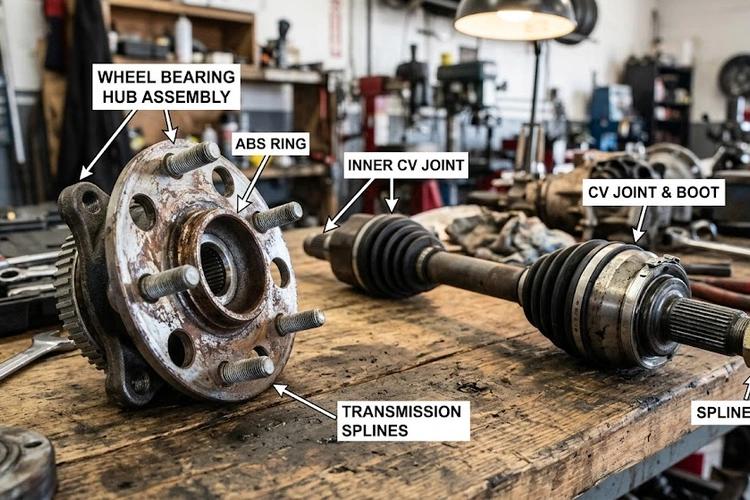
A steady hum that changes with road speed and a repeated click while turning can both come from the wheel or drivetrain area—but they do not point to the same component automatically. Wheel bearings support wheel rotation; CV joints transfer drive through changing angles as the suspension moves and the wheels steer.
Tyres, brakes, drivetrain components and other parts can produce overlapping noises. Use the conditions in which the sound occurs as clues, not as a reason to replace a part without inspection.
What does a wheel bearing do?
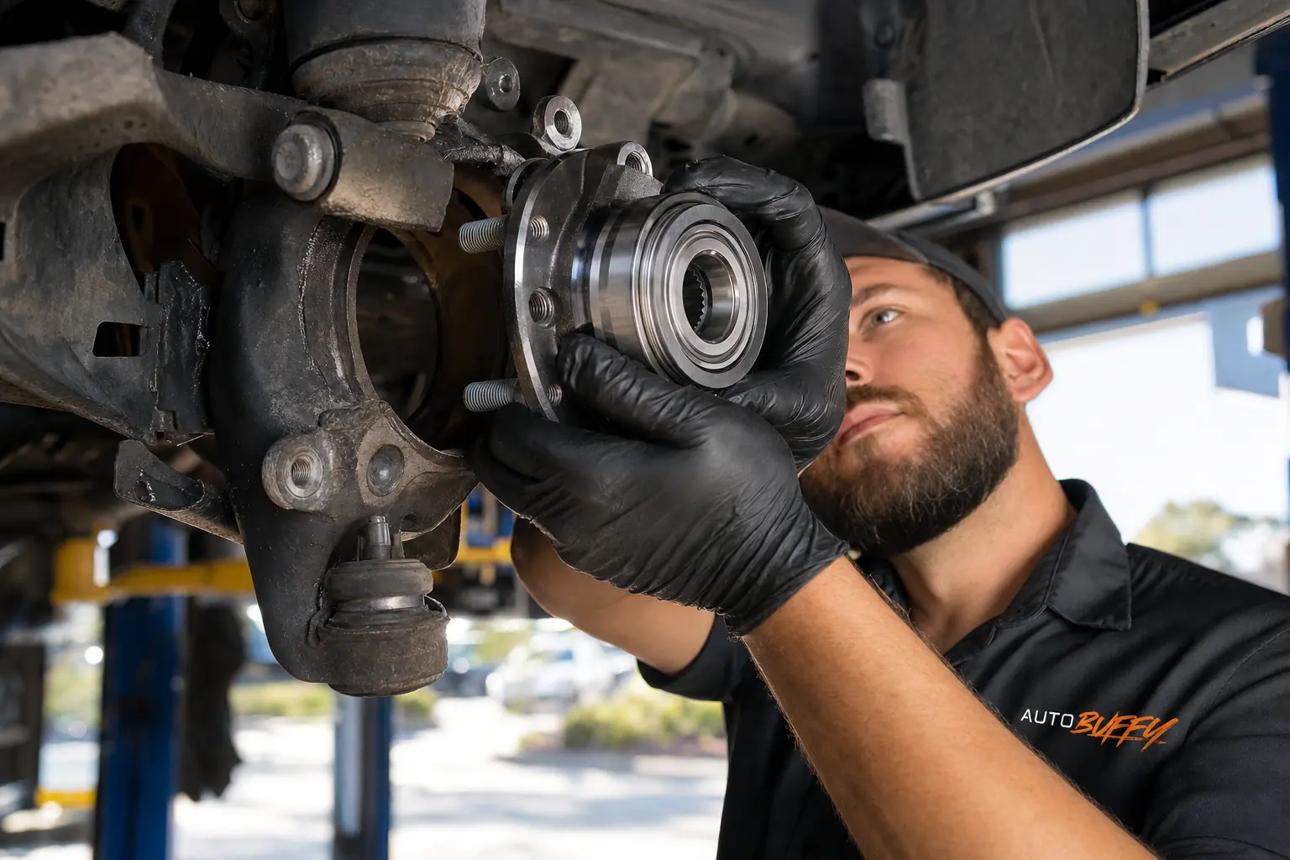
A wheel bearing allows a wheel to rotate smoothly while supporting vehicle loads. Wear or damage may produce a humming, rumbling or growling noise that changes as the vehicle moves. In some cases there may be play, vibration or other handling symptoms, but early faults may not produce an obvious steering-wheel vibration.
Noise can travel through the body, making it difficult to identify the affected corner from the driver's seat. Tyre wear and road surface can also create a hum, so a sound alone is not conclusive.
Common clues associated with a wheel bearing
- A hum, rumble or growl that increases with road speed.
- A noise that changes as the vehicle's load shifts through a bend.
- In some cases, wheel play, vibration or a roughness found during inspection.
- A noise that remains even when engine speed changes little, because it relates to vehicle movement rather than engine revs.
These are clues only. Tyres with uneven wear, cupping or certain tread patterns can sound similar, and a mechanic may need to inspect tyres, bearings and related components to determine the cause.
What is a CV joint?
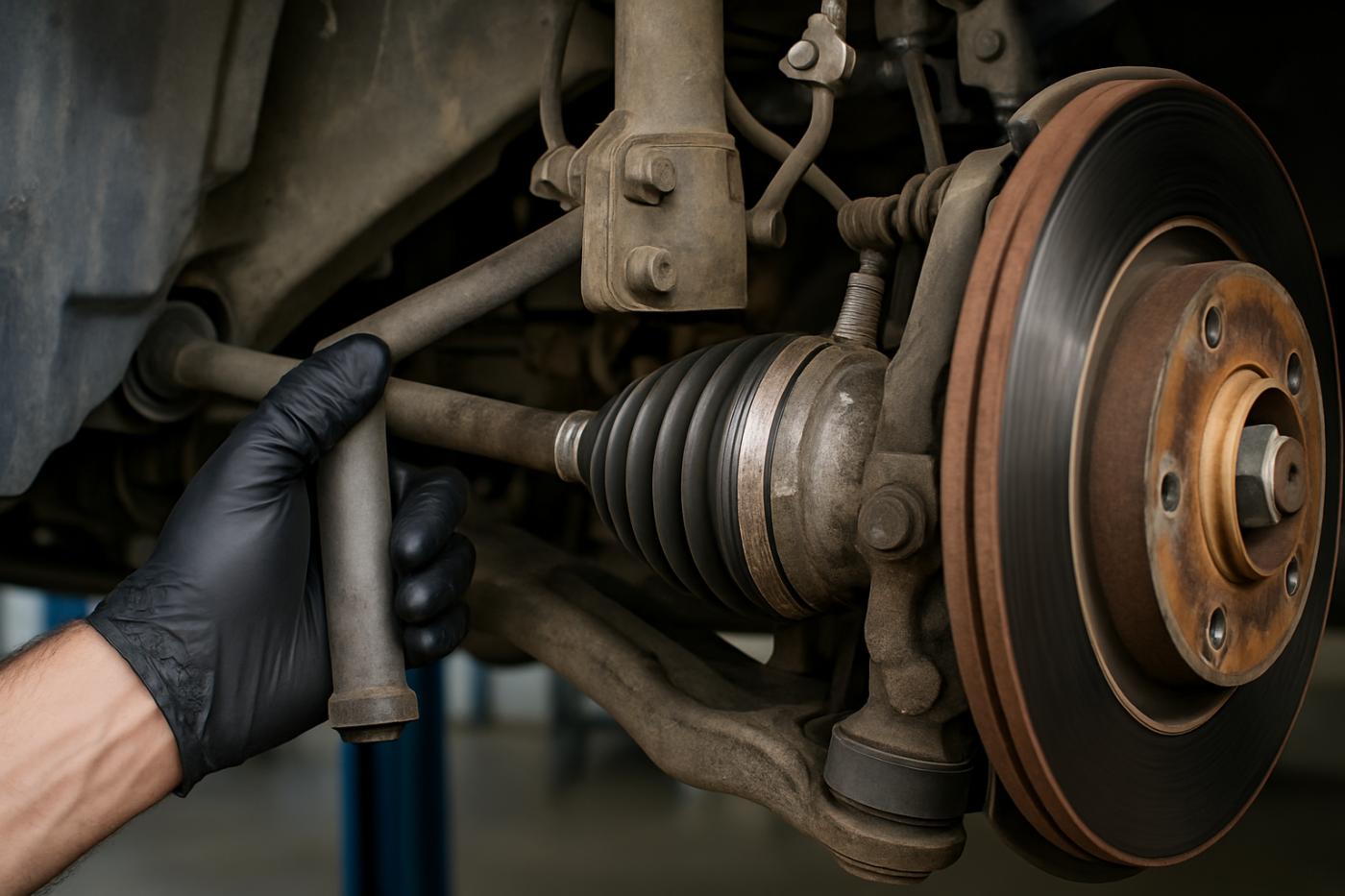
A constant-velocity (CV) joint transfers power from the drivetrain to a driven wheel while allowing movement from steering and suspension travel. Many front-wheel-drive vehicles use outer CV joints near the wheels and inner CV joints closer to the transmission or differential. Other drivetrain layouts vary.
The joint is protected by a flexible boot that holds grease in and helps keep dirt and moisture out. A torn boot can allow grease to escape and contaminants to enter, increasing the risk of joint wear. A damaged boot does not prove the joint has failed, but it should be assessed promptly.
Common clues associated with a CV joint
- A repeated clicking or ticking sound during a tight turn, particularly under drive, can be associated with an outer CV joint.
- Grease splattered around the inside of a wheel or nearby suspension parts may indicate a damaged CV boot.
- Vibration during acceleration can sometimes involve an inner CV joint or driveshaft, although other faults can cause vibration too.
- A clunk when changing between acceleration and deceleration may have several drivetrain or mount-related causes.
Not every clicking noise is a CV joint. Brake hardware, tyres, steering components or other parts may make noise during turns. Diagnosis should confirm the source before parts are ordered.
Wheel bearing vs CV joint: how the clues differ
A speed-related hum or rumble often leads a mechanic to consider the wheel bearing and tyres. A repeated click during a turn, especially under acceleration, may raise suspicion of an outer CV joint. However, these patterns are not diagnostic rules. A damaged bearing can make different noises, a CV joint can produce vibration, and unrelated components can imitate either symptom.
Tell the mechanic exactly when the sound occurs: turning left or right, accelerating or coasting, at low or high speed, over bumps or on smooth roads. Do not attempt high-speed weaving or aggressive turns to reproduce the noise.
| Observed clue | Wheel bearing may be considered | CV joint may be considered | Important limitation |
|---|---|---|---|
| Hum or rumble that rises with road speed | Bearing wear or damage; inspect hub and bearing condition | Less typical as the only symptom, though drivetrain faults can vary | Tyre tread, uneven wear and road surface can also create a similar hum |
| Repeated clicking during a tight turn under drive | Not the most characteristic pattern, but inspect nearby wheel and brake parts too | Outer CV joint wear is one possible cause | Brake hardware, tyres or steering parts can also click |
| Vibration during acceleration | Could be unrelated to the bearing; inspect the wider wheel and suspension area | Inner CV joint or driveshaft may be involved | Engine, mounts, tyres and other drivetrain faults can imitate this |
| Grease around the inside of a wheel | Not a typical bearing-specific clue | May indicate a split CV boot allowing grease to escape | Confirm the source and inspect the joint before choosing a repair |
What a mechanic may inspect
Depending on the symptom, a technician may inspect tyre tread and wear, check for visible CV boot damage or grease, assess wheel-bearing condition using suitable methods, check for play or roughness, inspect nearby brake and suspension parts, and perform a road test if safe. Some faults require the vehicle to be raised on proper equipment.
A road test can help reproduce the concern, but it should be done under safe conditions. Wheel-bearing and CV-joint diagnosis should not rely on a single sound description or a generic checklist alone.
Can I keep driving if I hear a hum or clicking?
Do not ignore a new or worsening wheel-area noise. If the sound is severe, the vehicle vibrates strongly, steering or handling changes, a wheel appears loose, or there is grinding or abnormal heat, stop in a safe place and arrange assistance. A seriously damaged bearing or drivetrain component can create a safety risk.
If the noise is mild and the vehicle otherwise feels normal, arrange an inspection promptly and avoid long journeys or unnecessary driving until the cause is understood. A torn CV boot should also be assessed before contamination causes more damage.
What affects wheel bearing replacement cost?
Cost depends on vehicle design, whether the bearing is supplied as a separate part or integrated into a hub assembly, access, parts availability, labour time and any related components that need attention. Some vehicles require additional procedures or tools, so a price from another model may not be a useful comparison.
Ask whether the quote includes the bearing or hub assembly, required fasteners, labour and any necessary checks. Confirm whether the affected side has been identified through inspection rather than assumption.
What affects CV joint or CV shaft replacement cost?
The repair may involve a boot, a joint or a complete driveshaft, depending on the vehicle and the confirmed condition. Parts availability, shaft design, access, seized components and the chosen replacement assembly can all affect the quote. A boot repair may be appropriate in some circumstances, but it is not automatically suitable if the joint has already suffered damage.
Ask what has failed, whether the joint itself is damaged, why a boot-only repair or full shaft replacement is recommended, and what parts and labour are included. Request approval before additional work is carried out.
| Quote item | What to confirm before approval |
|---|---|
| Part supplied | Is the quote for a separate bearing, a hub assembly, a CV joint, a boot or a complete driveshaft? |
| Diagnostic evidence | Which inspection findings support the identified fault and affected side? |
| Labour and extra parts | Are labour, required fasteners and any related work itemised? |
| Repair scope | Why is the proposed repair appropriate for this vehicle and the confirmed condition? |
| Approval and follow-up | Will the mechanic contact you before extra work, and what checks are included after repair? |
How to describe the noise when booking
- Describe the sound: hum, growl, click, knock or vibration.
- Note when it happens: road speed, turning, acceleration, coasting or bumps.
- Mention whether the sound is new, getting louder or intermittent.
- Report visible grease near a wheel, recent tyre work or previous suspension repairs.
- Share vehicle make, model, year and odometer reading if known.
Review the available service options, check Melbourne service-area information, or send a booking request. Explain the symptom so the appropriate diagnostic process can be discussed before booking.
This article explains possible causes and is not a remote diagnosis. A physical inspection is required to confirm the fault and assess whether continued driving is safe.