Brake and Rotor Replacement Cost Melbourne: 2026 Guide
Brake and rotor replacement cost in Melbourne typically runs $450–$1,600. Get 2026 price ranges, quote factors, and mobile mechanic savings before you book.
QUICK ANSWER BOX
Brake and rotor replacement in Melbourne typically costs $450 to $800 per axle for common family cars, and $900 to $1,600 for all four corners. European and performance vehicles cost more. The final price depends on rotor size, pad compound, caliper condition, and whether the labour happens in a workshop or at your home.
INTRODUCTION
A grinding noise at the Princes Freeway off-ramp is a terrible moment to learn what brakes cost. Most Melbourne drivers only think about the braking system when something squeals, shudders, or pulls to one side. By then, the cheap fix has usually passed.
The brake and rotor replacement cost Melbourne drivers face in 2026 sits inside a very wide band, and that band confuses people. One quote reads $420. The next reads $1,400. Both quotes can be completely honest.
This guide breaks down exactly where those numbers come from. You will learn what a fair price looks like for your vehicle type, which parts of a quote you can actually control, and which hidden costs never appear on a workshop invoice at all. You will also get a short preparation checklist that shaves real minutes off your labour bill.
Who this is for: Werribee, Tarneit and Point Cook drivers who want a fixed number before they hand over the keys.
TABLE OF CONTENTS
- What Brake and Rotor Replacement Actually Involves
- Brake and Rotor Replacement Cost in Melbourne: 2026 Price Ranges
- Why Two Quotes for the Same Car Look Nothing Alike
- The Hidden Costs a Workshop Invoice Never Shows
- Brake Shudder: The Problem, the Cause, the Fix
- How to Prepare for a Mobile Brake Service
- Brake Servicing Across Melbourne's Western Suburbs
What Brake and Rotor Replacement Actually Involves
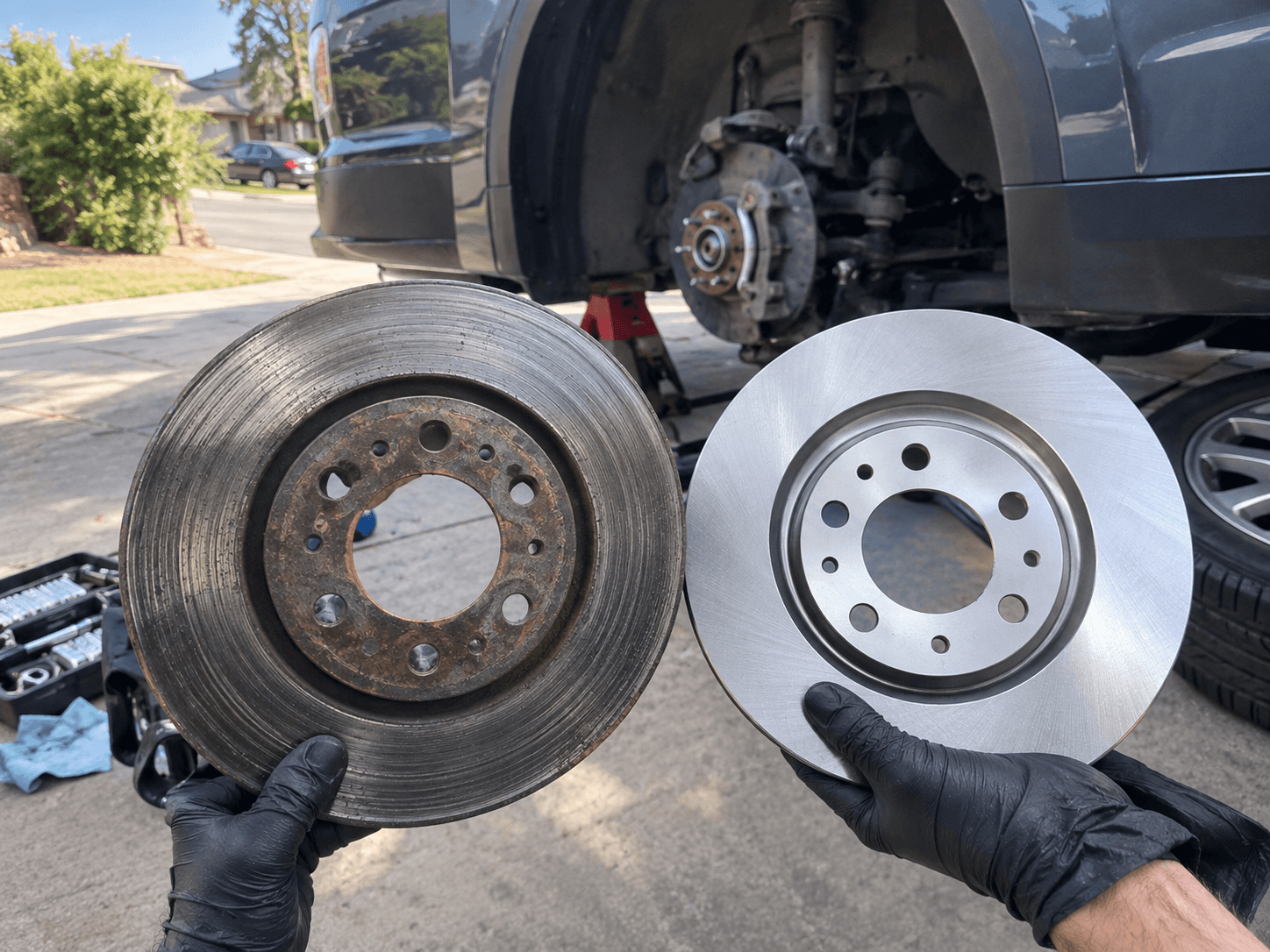
Brake and rotor replacement is defined as the renewal of both the friction material (the brake pads) and the metal discs those pads clamp against (the rotors), across one or both axles of a vehicle. Pads wear down. Rotors wear down alongside them, just more slowly.
A full job on one axle covers several steps. The mechanic lifts and secures the vehicle, removes the road wheels, unbolts the caliper, and withdraws the worn pads. The old rotor comes off the hub. The new rotor goes on after the hub face is cleaned back to bare metal. Caliper slide pins get cleaned and greased. New pads go in, the caliper is torqued to the manufacturer specification, and the pedal is pumped up before a road test.
That last part matters more than most drivers realise. New pads and rotors need a bedding-in procedure, which means a series of controlled stops that transfer an even layer of pad material onto the disc face. Skip it, and you get uneven deposits and shudder within weeks.
Rotors are not always replaced. Some discs can be machined (skimmed) on a lathe if they sit comfortably above the minimum thickness stamped on the hub. Machining costs less. It also removes metal, so a skimmed rotor runs hotter and wears out sooner. In my experience across Melbourne's stop-start western corridor, machining is false economy on anything past its second set of pads. Knowing the scope of the job makes the price ranges below far easier to read.
Brake and Rotor Replacement Cost in Melbourne: 2026 Price Ranges
Melbourne pricing in 2026 clusters into three tiers based on vehicle class. The figures below reflect typical parts-and-labour totals for a complete axle, using quality aftermarket components.
Small and mid-size cars — Toyota Corolla, Mazda 3, Hyundai i30, Honda Civic. Expect $420 to $650 per axle. Rotors are small, calipers are simple, and access is good.
Family SUVs and utes — Toyota RAV4, Mazda CX-5, Toyota HiLux, Ford Ranger, Kia Sportage. Expect $550 to $850 per axle. Larger rotors and heavier hardware push both parts and labour upward.
European and performance vehicles — BMW, Audi, Mercedes-Benz, Volkswagen Golf GTI. Expect $750 to $1,400 per axle. Many of these cars carry electronic park brakes that must be retracted with a diagnostic scan tool, plus wear sensors that need replacing every time.
The cost to replace 4 rotors and brake pads on a typical family SUV therefore lands between $1,100 and $1,600 in 2026. The average cost to change brakes and rotors across all Melbourne vehicle types sits near the $950 mark for a full four-wheel job. Answering how much to replace brakes and rotors Australia-wide is harder, because regional labour rates differ, though metropolitan Melbourne tracks close to Sydney and slightly above Adelaide.
Pads-only jobs cost far less. A front pad replacement on a small car runs $220 to $380 when the rotors still measure within specification. Understanding why the same car attracts two different quotes is the next piece.
Why Two Quotes for the Same Car Look Nothing Alike
Most competitors publish an hourly rate and stop there. That leaves drivers guessing. Six variables move a brake rotor replacement price up or down, and every one of them is checkable.
- Rotor size and design. A vented 330mm front rotor on a dual-cab ute costs three to four times a 260mm solid rear disc on a hatchback. Drilled and slotted performance rotors cost more again.
- Pad compound. Ceramic pads run quieter, produce less dust, and last longer than semi-metallic pads. They also cost 30 to 50 percent more. Bendix, Bosch and the vehicle manufacturer's own genuine range all sit at different price points for the identical fitment.
- Caliper condition. Seized slide pins or a sticking piston turn a straightforward job into a caliper rebuild or replacement. A single replacement caliper adds $180 to $450.
- Electronic park brake. Most vehicles built after 2015 need a scan tool to wind the rear caliper piston into service mode. No scan tool, no rear brake job.
- Wear sensors and hardware. European vehicles carry disposable pad wear sensors, anti-rattle shims, and single-use caliper bolts. These small items add $40 to $120 per axle.
- Labour location. Workshop rates in inner Melbourne run higher than outer-suburban rates. Mobile labour removes the overhead of a hoist bay entirely.
A common mistake I see is drivers comparing a pads-only quote against a pads-and-rotors quote and assuming one mechanic is gouging them. Read the line items, not the total. Line items also explain why the cheapest quote sometimes ends up costing the most.
The Hidden Costs a Workshop Invoice Never Shows
The sticker price on a brake job is only part of what the repair takes out of your week. Compare the two paths honestly.
The workshop path. You drive in before 8am, or you arrange a tow if the brakes are already unsafe. Towing across Melbourne's west costs $150 to $250. You lose a half or full day of work, which for a $40-per-hour earner is $160 to $320 in wages. If the workshop keeps the car overnight, a rental adds $60 to $90 per day. Add a rideshare to and from the workshop at $25 to $50 each way.
The mobile path. A licensed mechanic arrives at your driveway in Tarneit or your office car park in Point Cook. No tow. No lost wages. No rental. The total additional cost is zero, because the labour happens where the vehicle already sits.
The gap between those two paths regularly reaches $300 to $500 on a single brake job. That gap is real money, and no comparison site includes it in the headline price. There is one caveat worth stating plainly. Mobile service suits pad and rotor replacement, caliper swaps, and brake fluid flushes. It does not suit rotor machining, which requires a fixed lathe. Knowing when to book at all comes down to reading the symptoms correctly.
Brake Shudder: The Problem, the Cause, the Fix
The problem. You brake from 80km/h on the Western Ring Road and the steering wheel pulses in your hands. The pedal vibrates. The car still stops, so you keep driving on it.
The cause. Most drivers call this a warped rotor. Rotors rarely warp. What actually happens is uneven friction material transfer, known as disc thickness variation. Pad material builds up in patches on the rotor face, usually after a hard stop where the driver held the pedal down at a standstill and cooked pad material onto one spot. The pads then hit a thick patch and a thin patch on every rotation, and you feel it through the wheel.
The fix. Once thickness variation exceeds roughly 0.02mm, cleaning will not resolve it. The rotor needs machining or replacement, and the pads need replacing at the same time because they carry the same contamination. Fitting new pads to an old shuddering rotor guarantees the shudder returns.
A Werribee client brought me a 2019 CX-5 with exactly this fault last year. The previous shop had fitted new pads only, six weeks earlier, to save $200. The shudder came back within 400 kilometres. Replacing both rotors and both pad sets properly cost more than doing it right the first time would have. Preparation on your side reduces both the time and the bill.
How to Prepare for a Mobile Brake Service
Ten minutes of preparation shaves 15 to 30 minutes off labour time. No other Melbourne brake guide tells drivers this, and it directly reduces what you pay.
- Clear a flat, hard surface. Concrete or sealed asphalt only. Jack stands sink into gravel and soft ground, and a mechanic will refuse to lift on an unsafe base. A level driveway or a marked office car bay is ideal.
- Leave a metre of clearance on both sides. The mechanic needs room to swing a breaker bar and set out tools. Move bins, bikes and the second car before the appointment.
- Locate your wheel lock key. Locking wheel nuts stop the job dead. The key usually lives in the glovebox, the boot side pocket, or the spare wheel well.
- Have your service history ready. Knowing the date and odometer of the last brake service tells the mechanic whether rotors are on their first or third pad set. Photos of the logbook pages work fine.
- Note the symptoms in writing. Squeal at low speed, shudder under heavy braking, pedal travelling too far, a burning smell after a hill descent. Specific symptoms narrow the diagnosis immediately.
- Park facing out where possible. It makes the post-service road test quicker.
- Keep pets and children indoors. Wheels come off and the vehicle sits on stands.
That preparation matters most in the suburbs where distances and traffic eat the day.
Brake Servicing Across Melbourne's Western Suburbs
Werribee, Tarneit, Point Cook, Hoppers Crossing and Truganina share a specific braking problem: heavy stop-start commuting into the CBD combined with school-run traffic and shopping trips to Pacific Werribee. That duty cycle wears front pads faster than open-road driving does.
Drivers in these suburbs also face a scheduling squeeze. A workshop appointment in Laverton or Altona costs a morning even before the repair starts. The M1 corridor at 8am makes a 12-kilometre trip take 40 minutes.
Mobile brake service removes that trip entirely. A qualified mechanic carries rotors, pads, fluid and a diagnostic scan tool to your address, completes a single-axle job in roughly 60 to 90 minutes, and road tests the vehicle before leaving. Four-wheel jobs run closer to two to three hours.
Vehicle safety is not optional in Victoria. Brakes must meet the requirements set out under Victorian roadworthy standards, and a vehicle with rotors below minimum thickness will fail a roadworthy inspection outright. Any brake work performed also needs to be recorded properly so your new-car warranty stays intact, which means logging the parts fitted and the odometer reading against the service schedule.
Fixed pricing, quoted before the mechanic arrives, removes the last unknown. You approve a number, that number does not move, and the car never leaves your driveway.
According to VicRoads, faulty brakes can qualify as a major vehicle defect, meaning the vehicle may not be fit to drive on the road. The RACV also recommends obtaining a written repair estimate that sets out the expected work, parts and labour costs before repairs begin. These principles support the value of clear brake-service quoting and proper inspection. Our mechanics should only state qualifications, licences and years of experience that can be independently verified.
Frequently Asked Questions
How much does it cost to replace brakes and rotors in Australia?
Replacing brakes and rotors in Australia typically costs $420 to $850 per axle for mainstream vehicles, and $750 to $1,400 per axle for European or performance models. The question of how much to replace brakes and rotors Australia-wide has no single answer because labour rates vary between capital cities and regional centres. Melbourne pricing generally tracks close to Sydney and sits slightly above Adelaide and Hobart. Parts quality is the other major variable, since ceramic pads and premium rotors carry a meaningful price premium over budget-grade components.
What is the best way to tell if my rotors need replacing or just machining?
The best way to tell is to measure the rotor thickness against the minimum figure cast or stamped into the disc hub. If the rotor sits more than about 1.5mm above that minimum and shows no cracking, deep scoring or heat spotting, machining is a valid option. If the rotor is close to minimum thickness, is on its third set of pads, or shows blue heat discolouration, replacement is the correct call. Machining removes metal permanently, so a skimmed rotor dissipates heat less effectively and wears through its next pad set faster.
Can a mobile mechanic replace brake pads and rotors in my driveway?
Yes, a qualified mobile mechanic can replace brake pads and rotors at your home or workplace, provided the vehicle sits on a flat, sealed surface with room to work safely around it. The mechanic brings jack stands, torque wrenches, brake fluid, and a diagnostic scan tool for vehicles with electronic park brakes. A single-axle replacement usually takes 60 to 90 minutes. The only common brake task that cannot be done on-site is rotor machining, because that requires a fixed workshop lathe.
How long does a brake and rotor replacement take?
A front or rear axle brake and rotor replacement takes 60 to 90 minutes for most vehicles, including the road test and bedding-in procedure. A full four-wheel job takes two to three hours. Vehicles with electronic park brakes add 15 to 20 minutes for scan tool retraction and recalibration. Seized caliper slide pins or badly corroded rotors that need to be cut off the hub can extend the job by another 30 minutes, which is why clearing the work area beforehand genuinely saves you money.
What is the cost to replace 4 rotors and brake pads on a family SUV?
The cost to replace 4 rotors and brake pads on a family SUV such as a RAV4, CX-5, or Sportage typically ranges from $1,100 to $1,600 in Melbourne during 2026. That total covers four rotors, two complete pad sets, hardware, caliper servicing and labour. Utes with larger front rotors sit at the upper end of the range. European SUVs carrying wear sensors and single-use bolts can exceed $1,800. Splitting the work across two visits, front axle first, is a legitimate way to manage the cost.
Is it worth replacing brakes and rotors at the same time?
Replacing brakes and rotors together is worth it in most cases, because new pads bedded onto a worn or uneven rotor face wear unevenly from day one. A grooved rotor also reduces the contact area of the new pads, which lengthens stopping distance until the pads wear into the grooves. If the rotors measure well within specification and show a smooth, even face, fitting pads alone is reasonable. Once a rotor is on its second pad set, replacing both together almost always costs less over the following two years.
What is the most common mistake people make with brake repairs?
The most common mistake is waiting until the brakes grind before booking any work. Grinding means the pad friction material is gone and the metal backing plate is cutting into the rotor face. At that point a $250 pad replacement becomes a $650 pad-and-rotor job, and a seized caliper can push it higher again. The second most common mistake is skipping the bedding-in road test after new parts are fitted, which causes uneven material transfer and brings brake shudder back within weeks.
CONCLUSION
The brake and rotor replacement cost Melbourne drivers pay comes down to three things: the size and design of the parts your vehicle needs, the condition of the calipers and the hardware behind them, and where the labour is done. Get those three answers in writing, and the guesswork disappears.
The savings most drivers overlook are the ones that never appear on an invoice. Removing a tow, a lost work day and a rental car from the equation is often worth more than the difference between two parts quotes.
Book a fixed-price mobile brake inspection at your Werribee, Tarneit or Point Cook address and get the number before the spanners come out. Share this guide with anyone who has been putting off a squeal, and tell us in the comments what your last brake job cost.
Need Professional Vehicle Assistance?
Our trusted mobile mechanics come directly to your location for repairs, diagnostics, maintenance and emergency roadside assistance.